“Bahumbug!”
Actor Parker Danzey’s voice boomed across the stage and the carolers sang “It Came Upon a Midnight Clear” to introduce Dickens’ classic tale, A Christmas Carol. From the start the actors revealed a tension among themselves and Scrooge. Scrooge’s nephew played by Phoenix Plante, as well as Bob Cratchit, played by Sam Pearson, introduced us to the main characters of the story. Cratchit, a poor man whose only day off a year is Christmas, and Scrooge who, as everyone knows, hates Christmas and the people who come begging for money during the holiday season. Danzey portrayed Scrooge’s hatred for Christmas and the poor in a way that immersed the audience into nineteenth century England. His voice was loud across the stage and he moved frantically just like the animated film from 2009. Because of his emotion and body language, viewers didn’t feel like they were watching the show, they felt like they were someone in the town who knew Scrooge and his dreary ways.
Jacqueline Goldfinger’s adaptation of the original Christmas Carol worked perfectly for the Pinkerton Players as they captured the magic of the original story, along with stage trick elements only a play could provide. One we specifically liked was the scene where Marley’s face appears on Scrooge’s doorknob. Of course, this isn’t possible in a live play, so the crew used a mesh screen on Scrooge’s front door window that Marley stuck his face through to recreate that moment from the movie. This worked well because we could only see the outline of Marley’s face, and Scrooge’s horrified reaction–making everyone in the audience laugh when he jumped back falling to the stage floor.
Another trick the stage crew used was a moving set. Scrooge’s front door could be turned around and become his bedroom for different scenes. The set was ideal when Christmas past pulled Scrooge through his bedroom window to go back into his memories of his old school. Although they could not fly, the stage crew turned the entire set around to show him climbing out of his front window. This technique kept the story moving smoothly and didn’t take away from the magic of the original story.
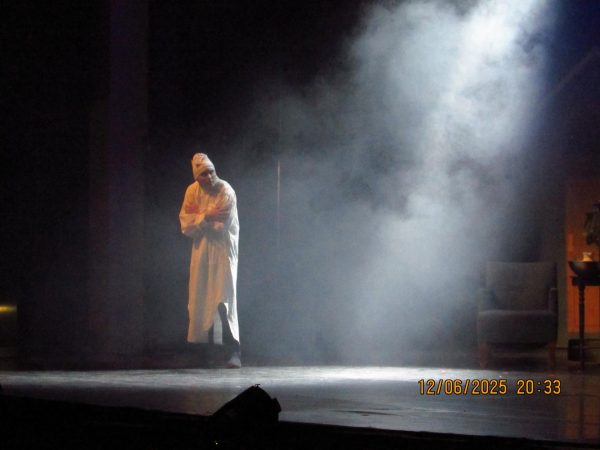
Like the traditional version of the play, the audience was introduced to the ghost of Christmas Past (Inky Stevens). As she entered the stage, fog billowed out to show her eerie presence, a nice stagecraft. Then we meet the ghost of Christmas Present, played by Kennedy Furner, who shows us tiny Tim and the Cratchit family, and sprinkles Christmas cheer (glitter) on the people of the town. Scrooge’s final encounter happened when Christmas Future approached with his creepy skeleton-ish makeup and silence, along with the actor Matthew Navarro’s slow intimidating movements, kept spectators anticipating what would come next.
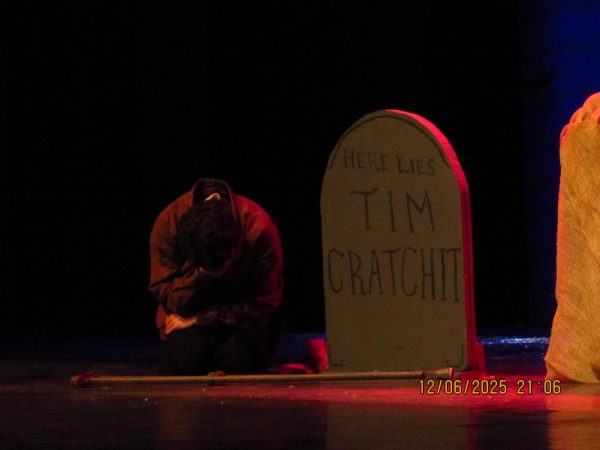
Taking Scrooge to see the tombstones of Tiny Tim and his own headstone, Scrooge watched as Bob Cratchit knelt in grief over the loss of his son. Next to his grave still covered in burlap, Scrooge was unable to remove the burlap covering his gravestone. Danzey as Scrooge kept things professional though, acting right on cue. Of course, this mishap was not his fault, but the lack of seeing “Ebenezer Scrooge” took one out of the moment a bit.
In its classical ending, the play ended with Scrooge seeing the error of his ways and changing his heart. The cast gathered together to welcome everyone “A Merry Christmas and a Happy New Year.”
“My favorite moment was the opening scene with Sam and everyone,” said Danzey. “I also enjoyed acting with the Kennedy Furnner who I have worked in the theater for so long.” This is both Danzey and Person’s Senior year at Pinkerton, after having done theater all four years.
The play was a great success with amazing actors and classic story telling that stayed true to Dicken’s original novel.